Post-Attack Reconnaissance Report
On March 13 1944, USAAF F-5 Snapper II conducted a high-altitude photoreconnaissance sortie over Dresden to assess post-strike damage. This sortie was partially completed at significant risk due to prevailing unexplained weather conditions over the target, and the pilot has subsequently been recommended for a Distinguished Flying Cross. The aircraft suffered extensive damage, and photofilm exposed over the target area proved to have been damaged beyond recovery – this is presumed to be a result of the energies involved in the employment of Big Boy. The attached report is based on the pilot’s eyewitness account, as debriefed immediately on landing.
Pilot’s Report compiled by Maj. K. Andreasson, Intelligence Officer, 145th Special Bombardment Detachment USAAF
- The weather was reported to be excellent from the coast all the way to near the target area, with only scattered high cloud.
- No enemy interception attempts or anti-aircraft fire were encountered.
- Approximately 150 miles north-west of the target area, the pilot observed that several of his instruments appeared to have ceased functioning. Despite this, he continued with the mission.
- At around this time, the pilot noticed that the weather appeared to have worsened almost instantly, noting a massive increase in turbulence and decrease in visibility.
- Despite the deteriorating situation, the pilot pressed on, having been briefed pre-flight as to the importance of his mission.
- Approximately 75 miles north-west of the target area, the pilot stated that visibility was now ‘almost zero’, turbulence was as bad as he had ever known, and that he believed himself to be flying in some form of extremely dense thundercloud.
- By the pilot’s best estimate, his altimeter, airspeed indicator, and artificial horizon failed simultaneously when approximately 60 miles north-west of the target area, and both engines began to overheat rapidly.
- At this time, the pilot took the decision to lose altitude in order to clear the ‘thundercloud’ and regain his bearings, as he could no longer rely on his instruments for navigation.
- He therefore performed a shallow, rapid dive, exiting the base of the cloud layer and what he estimated to be approximately 11,000ft altitude and 270-280kts.
From this point, I have reproduced the pilot’s testimony in its entirety, following his exiting the clouds.
“As soon as I came out of the murk, my whole cockpit lit up from outside. I mean, it was bright as sunlight, but…under the thickest, nastiest cloud deck I’ve ever seen. Honestly, it was creepy. There was no way the sun should be penetrating… but there the light was, bright as day.
I guessed I was at about 10-11,000 feet, so I started levelling off to try and work out where the hell I was based on ground features. Once I’d got her trimmed out and throttled back a little, I banked and tried to get a bearing on anything recognizable below me.
I picked up the river pretty quick – at least, it followed the same line as the river. I figured I’d ended up short of the city, because I couldn’t see any big concentrations of buildings. It all just looked like grey fields covered in rocks, with a few buildings here and there casting weird, long shadows in the ‘sunlight’. It was so quiet, and still, no flak at all. The turbulence had stopped, and it felt like I was barely moving through the air at all.
I think that was what snapped me out of it, to be honest, the stillness. I checked my gauges for my airspeed, and they were no help – still seized solid. So, I looked out of the canopy again, and the starboard engine was just windmilling, completely dead. Looked the other way, same deal on the port side. That shook me up alright!
I started to go through the air-start procedures, and I had my head down in the cockpit when I felt the most enormous lurch and bang under the aircraft. It was like I’d dropped 500 feet in an air pocket, and then a giant had swung a bat and hit me in the backside as I was dropping. The plane went tumbling and spinning, and I guess I must have blacked out.
When I came back ‘round I was inverted, in a shallow dive, maybe at about 3,000 feet, but stable. I panicked and snatched a big fist of aileron to get her the right way up, and thank God she responded normally. I figured I’d been hit by flak, maybe one of those new rockets, and all I wanted to do was get the hell out of Dodge and as far away as possible before I had to bail out.
As I was rolling level, though, I got a hell of a lot closer look at the ground than I’d planned. What I thought were grey fields was a mass of rubble, whole streets and blocks just smashed to tiny bits and thrown all over the place, as far as I could see. It looked like someone took a hammer to the whole damn city, and just left a couple of buildings standing here and there. It wasn’t just knocked over, or burned, it was completely flattened, like it had been levelled by a road-crew almost.
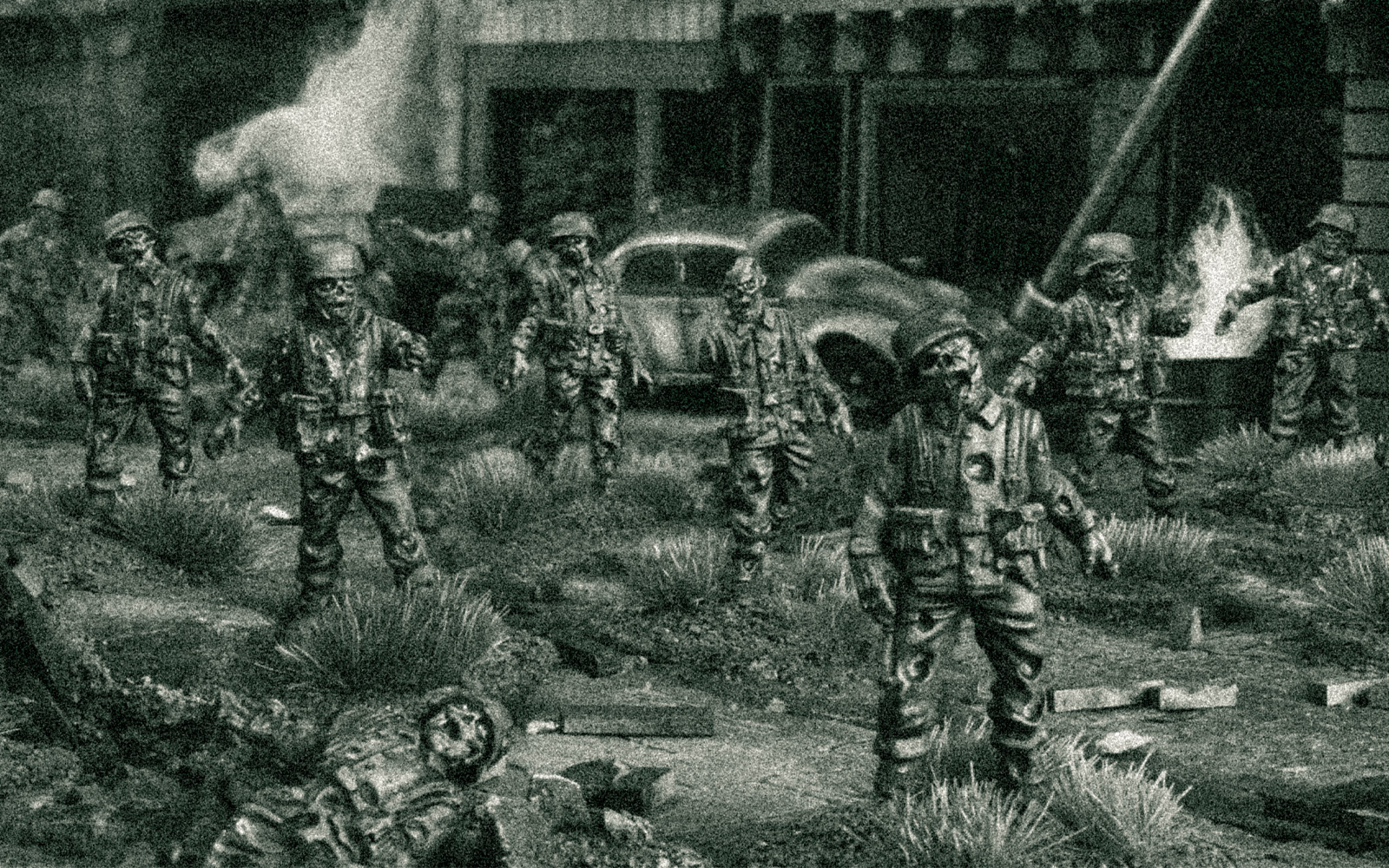
The weird thing, though, was the rubble… it looked like it was moving. Not the rubble itself, but the whole mass, crawling, shifting somehow. I’m not sure, and I’m not sure how it’s possible, but I could swear it looked like… people, masses of people. My guess is it was just an optical illusion, heat-haze or something weird from the bomb distorting the air, but it creeped the hell out of me.
Anyway, I got her flying normally again, or at least gliding, and I figured I may as well try the engines again. I didn’t fancy hitting the silk within a thousand miles of whatever the hell was going on down there. On the third go, I managed to get the port side running, thank God, and the starboard came back after a couple more tries. On an ordinary sortie I’d’ve climbed like hell for the clouds, but after what I’d just been through I wasn’t going back up there. I shoved the throttles forward and went hell-for-leather, right on the deck, all the way until I hit the Dutch coast. Didn’t give a damn about flak, or fighters, or fuel. I just wanted to get out of there.
About… two hundred miles north-west of Dresden I got most of my instruments back, except the fuel gauge, and the cloud cover was more or less back to normal. Still didn’t chance a climb, though. The buffeting had been hell on the way in, and I had no idea how she was still flying after the whack we’d taken. I just kept right on motoring, and once I got out over the Channel I got on the radio right away, requesting the nearest secure field, and telling them to get you down there with an armed guard, which the Limeys jumped to pretty quick once I gave them my codes.
I got Martlesham Heath off my nose, and I had no idea if the gear would come down or not, especially the front. I saw the crash-cart standing by, and since I figured I must be almost out of gas I just put her straight at the runway. Landed like I was in a dream, to be honest with you. Rolled to a stop, and I’ve never been so goddamn glad to see you pull up in the Jeep.”