In the first of what will be a series of Bolt Action tutorials, we’re looking at what makes up a standard Rifle Platoon, and how it forms the foundation of every Bolt Action army. As our starting point, we’re using the British & Canadian Infantry (1943-45) boxed set – this can be built in a wide variety of ways, and might seem a bit intimidating when you first look at all the options on the sprues!
Don’t worry; this guide will show you how these options come together to form a solid core for a Bolt Action army. We’ll also give you a window into how British doctrine shaped its infantry in real life, which may help you build, paint, and play with just a little more historical insight. Let’s get to it!
Beyond National Identity
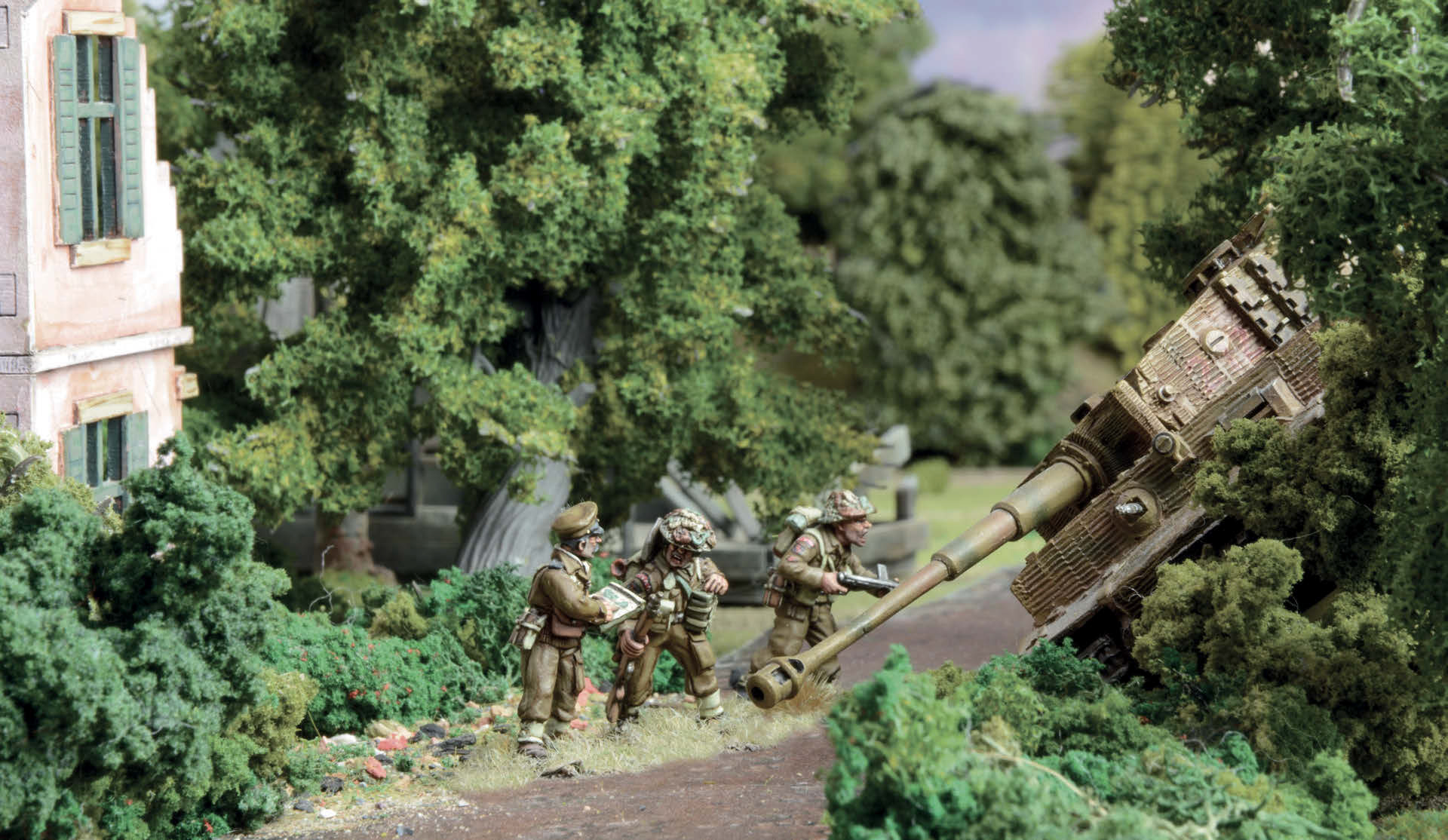
Picking a nation is just the starting point. In Bolt Action, the real flavour of your force comes from the Rifle Platoon you build it around. Even within a single faction, that core platoon can dramatically change how your army feels on the table.
One British player might field a disciplined line of Guards Infantry supported by mortars and Brens defending France in 1940, while another may field minimum sized Rifle Sections with NCOs with SMGs designed to be an aggressive motorised formation from North Africa.
Historical Background
By 1943, the British and Canadian infantry platoon had become a well-drilled, highly adaptable fighting unit. Each followed the standard War Office structure: a small platoon headquarters supported by three rifle sections, each built around a Bren light machine gun. The Bren was the platoon’s beating heart — accurate, dependable, and capable of effective sustained fire.
Officers were trained to use coordinated section fire and smoke from the platoon’s 2-inch mortar to mask assaults. For anti-tank defence, PIATs (Projector, Infantry, Anti-Tank) were held at company level but often temporarily attached to platoons when armoured threats were expected. This gave infantry a fighting chance against tanks and half-tracks without needing dedicated armour support.
A typical late-war platoon was organised around a platoon commander — usually accompanied by a sergeant and two to four other ranks, including a signaller and runner — plus three rifle sections and a 2-inch mortar for close support. On paper, each section was ten men strong, centred on a Bren gun team and led by an NCO, but in practice platoons rarely operated at full strength for long. Attrition and detached duties often reduced sections to seven or eight men.
In Bolt Action
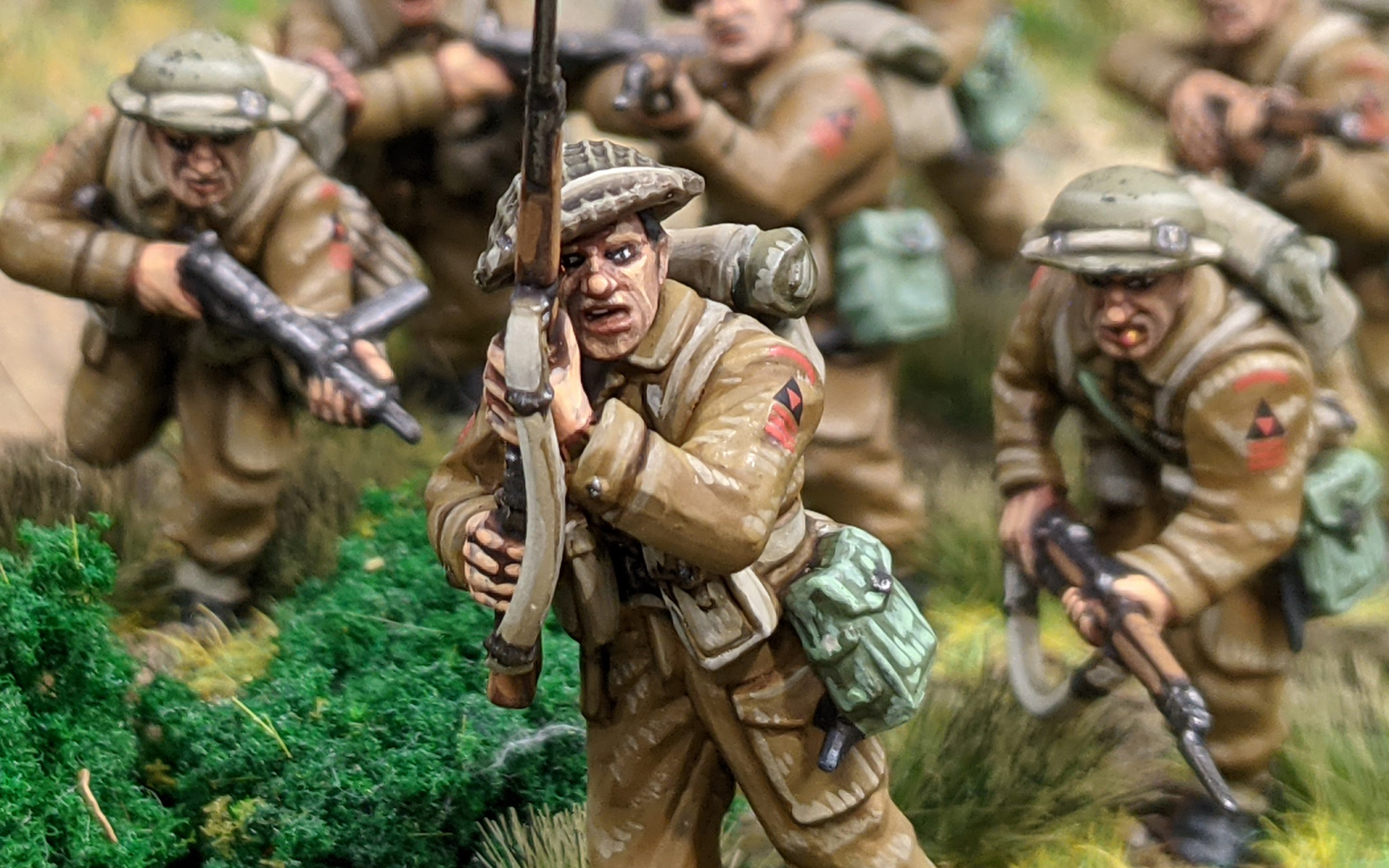
British and Canadian infantry have a proud tradition of determination and resolve in the face of the enemy. Building their squads around the Bren gun gives them consistent firepower and solid reach. A typical six-man section with a Bren and the trusty Lee-Enfield rifle provides dependable shooting that wins games through positioning and patience rather than sudden bursts of luck.
The British national special rules reward this methodical style. The Fix Bayonets rule allows those six-man sections to roll eight dice in close quarters, giving you flexibility without needing to dedicate entire squads to melee. This makes each section a genuine all-rounder, able to maintain steady ranged fire and still punch above its weight if combat closes in.
You can also lean into that tactical flexibility. The 2-inch mortar is small and easy to include, but its smoke rounds can be invaluable for protecting advancing troops or blocking enemy lines of sight, as well as dropping HE on the enemy. Meanwhile, the PIAT team offers a low-cost answer to enemy armoured vehicles or transports, letting your infantry stay effective without needing armour support of their own.
Options such as the Forward Artillery Observer, which can be assembled alongside your Officers, add another layer of board control. The Artillery Support rule allows you to roll two dice and keep the higher result when calling in smoke or artillery barrages, helping ensure that support arrives where and when it is needed.
Playing with a British or Canadian Rifle Platoon teaches good habits early. Success comes from coordination and timing, not reckless charges. You will win games by forcing bad trades and controlling the pace of engagement, relying on overlapping fields of fire and clear command from your Officers. Their Come on, lads! rule keeps your infantry moving and morale high even under pressure.
Building from the Box
A single British & Canadian Infantry box gives you everything you need to build a balanced Rifle Platoon.
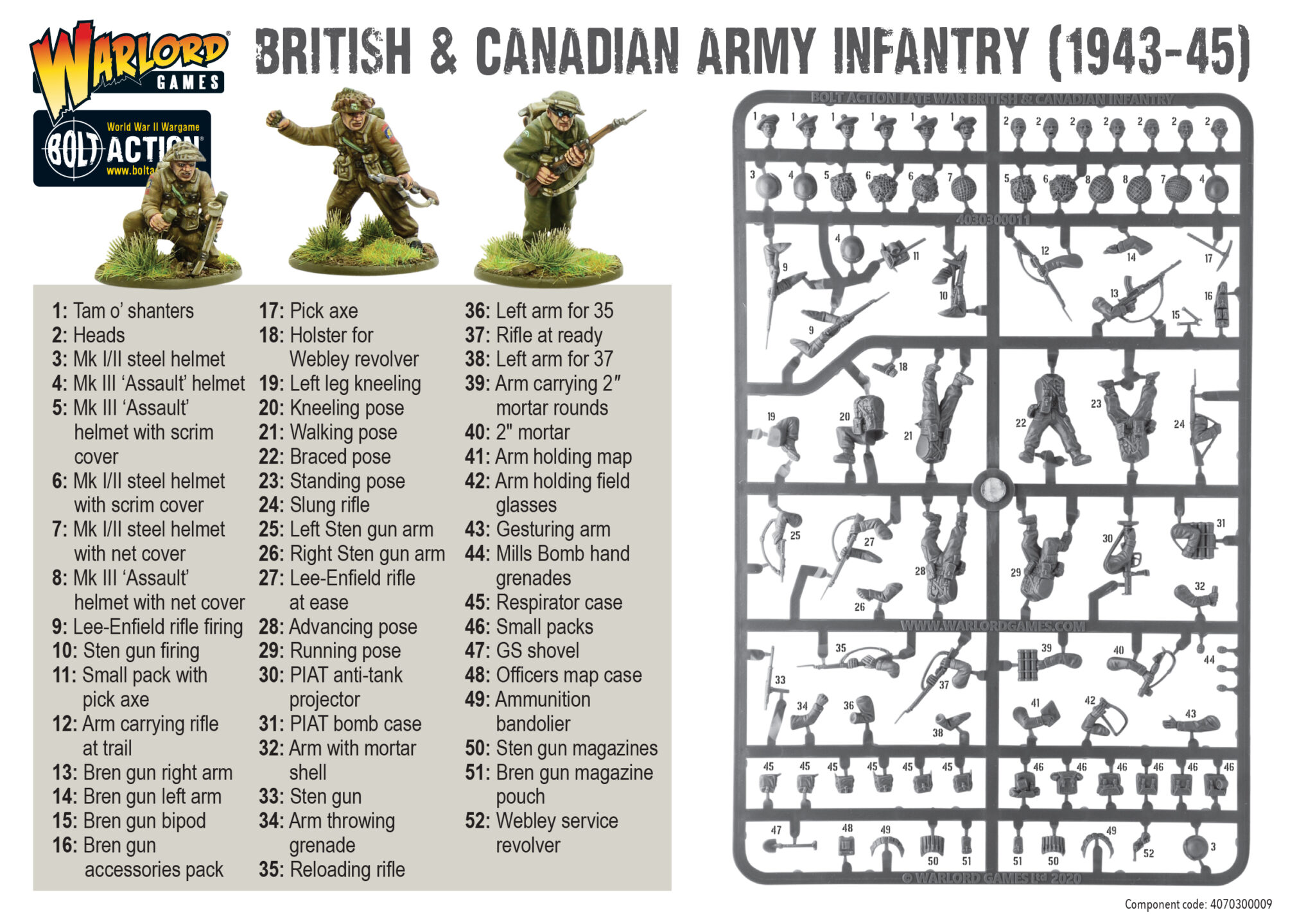
Your first decision should be whether to field your platoon commander on his own or with a supporting squad. The Army Special Rule of Come on, lads! means the morale bonus your platoon commander gives to units within 6” is increased to +3, so your troops can accumulate a lot of pins before they are likely to fail morale and order tests. The downside of this is that it reduces the officer’s cover saves by 1, so it’s usually best to field them in units that include 2-3 extra men for survivability.
Any of these can have an SMG or a pistol – this really comes down to whether you want to use them aggressively or not. Many people choose to give one or two models in the HQ squad an SMG, so that they can provide support to the rifle sections if needed – plus, it looks cool! This combines with the Fix Bayonets! rule so that even a unit of 3 men with 2 SMGs would roll 4 dice in close combat with 2 rerolls, making the unit a dangerous prospect to charge, especially in cover.
Next come the rifle sections – you need a minimum of two in each rifle platoon. In real life British Army sections of ten men were split into a rifle group and a gun group, containing the Bren. You can replicate this by choosing five man units, giving half of them a Bren and arming the other half with rifles with the option of an SMG for the NCO.
Alternatively, you can build your units as full ten man squads with both an SMG and Bren. These squads are going to be more durable on the battlefield (benefitting from the At Full Strength rule until they take casualties), but lack the flexibility of the smaller squads. There are pros and cons to either approach – you can of course take a mix of both, or choose units of 6-8 men to represent a platoon that has previously taken casualties.
Finally you have the option to build 2-inch mortar and PIAT teams. While the light mortar only has a 1” HE template, it is a very cost effective way to threaten your opponent’s weapons teams, and can also lay smoke. Similarly, the PIAT has a shorter range than most other infantry anti-tank weapons, but at only 40 points you can deny areas of the battlefield to enemy armour.
Check out what this looks like as an army list!
| Unit Name | Extra Soldiers | Weapons | Points Cost |
| Platoon Commander (Regular) | 1 extra man | 2x SMG | 48 |
| Rifle Section (Regular) | 2 extra men | 1x SMG, 1x LMG, 5x rifles | 99 |
| Rifle Section (Regular) | 2 extra men | 1x SMG, 1x LMG, 5x rifles | 99 |
| Rifle Section (Regular) | 2 extra men | 1x SMG, 1x LMG, 5x rifles | 99 |
| Light Mortar Team (Regular) | 1x Light Mortar | 30 | |
| PIAT Team (Regular) | 1x PIAT | 40 | |
| Total Points: | 417 | ||
| Order Dice: | 7 |
As you can see, this one box gives you lots of flexibility and provides the core of a playable force. You can increase the points value by giving your platoon the Guards special rule and/or making them Veteran. Most people aim for 750 points for their first few games – with this Rifle platoon at the core of your army you could add a Heavy Weapons or Artillery platoon (in which case you may want to save a couple of plastic models to make HQs), or an Armoured platoon.
You might also want to add some HQ units, especially a Forward Artillery Observer as he’ll benefit from the Artillery Support Army Special Rule, which makes their barrages more reliable. Transports are also useful for extra mobility on the battlefield.
Steady, reliable, and flexible, British and Canadian platoons reward disciplined play, combining consistent firepower with just enough grit to turn defence into victory.
Modelling Options
Each sprue includes plenty of head options: the traditional Mk II steel helmet, the later Mk III helmet and the tam o’shanter (the soft bonnet worn by Scottish and Canadian Highland troops) both feature prominently. The tams are a great way to give your platoon a Highland or Canadian character, while the helmeted heads work perfectly for Guards or any late-war infantry formation in Northwest Europe.
There are a range of hands and arms that can be used to identify your platoon commander and NCOs – binoculars, maps, a pistol hand and one signalling. As well as looking evocative, it’s worth putting a bit of thought into how you model your officers as it will help you identify them on the battlefield.
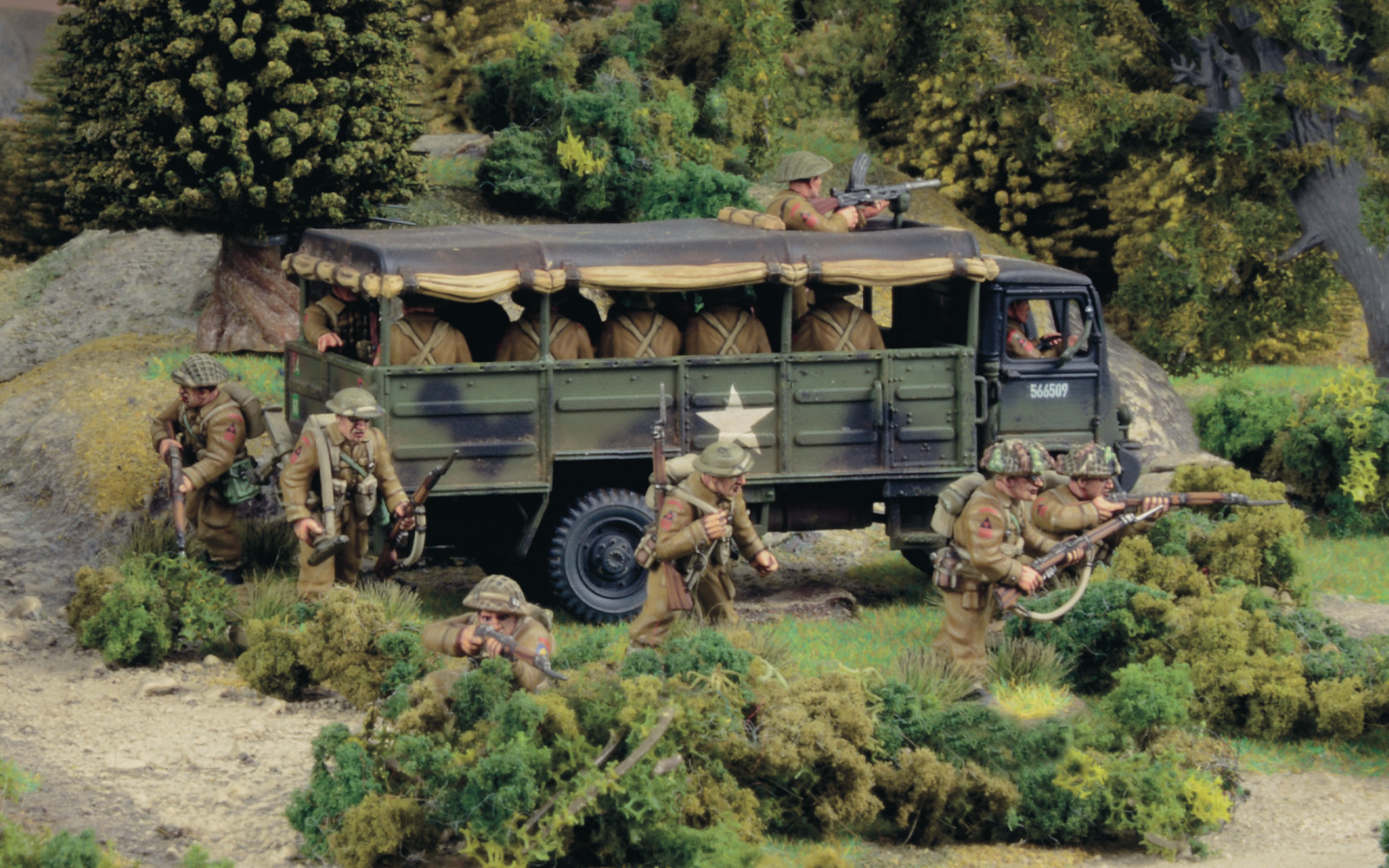
There is no single right answer on how to assemble your models. The British Army of 1943-45 was a mix of uniforms and regimental traditions. Whether you build your force as a clean, uniform Guards platoon, or add a few Highland touches for variety, it will still look authentic on the table. The box gives you the flexibility to make the models your own while staying true to the history that inspired them.
If you want even more variety, the British & Canadian Infantry (Winter) box includes extra weapons, greatcoat bodies, and additional gear options. It’s perfect for converting Engineers or adding cold-weather character to your force, and combining the two sets gives you a huge range of parts to expand your army into a larger, fully themed Bolt Action collection.
Ready to start building your first Bolt Action platoon?