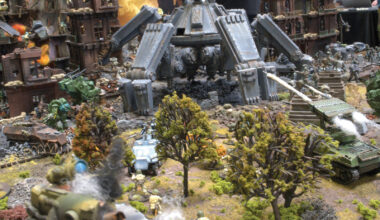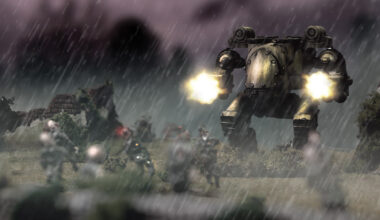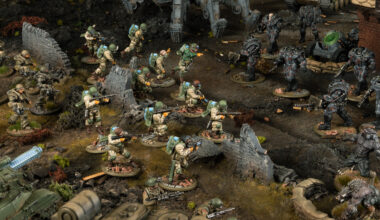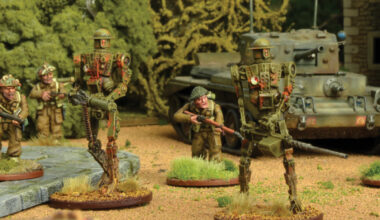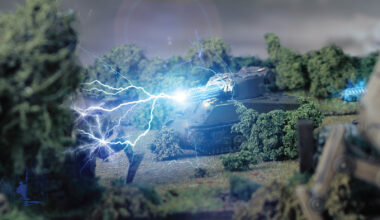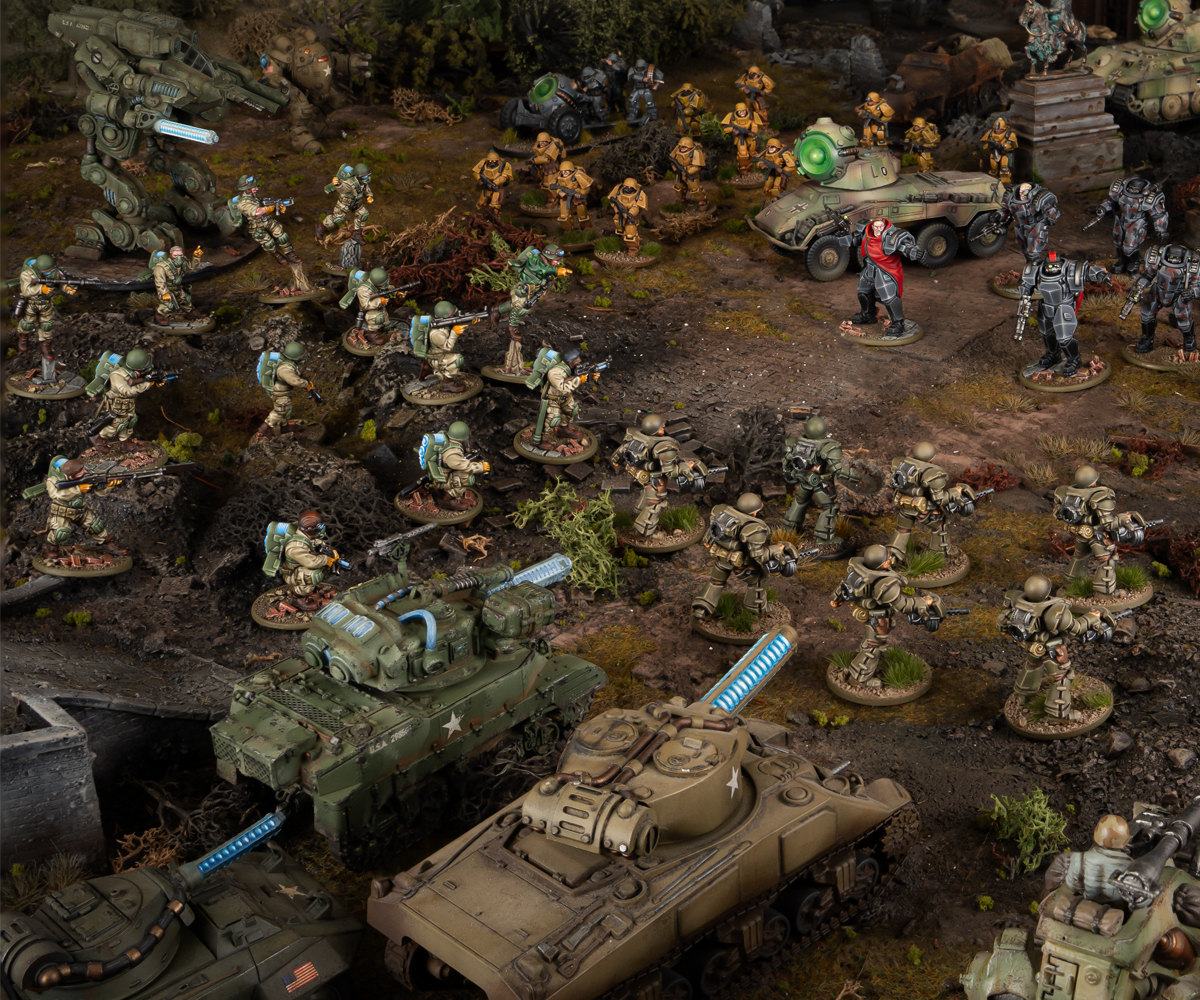
Konflikt ’47 mastermind Kris is back once again with a deep dive into the mechanics of the Rift wars. Today, he’s breaking down how US players can get the most out of their signature Rift weapons – it’s time to ride the lightning with the crackling power of Tesla!
The Spark of Innovation
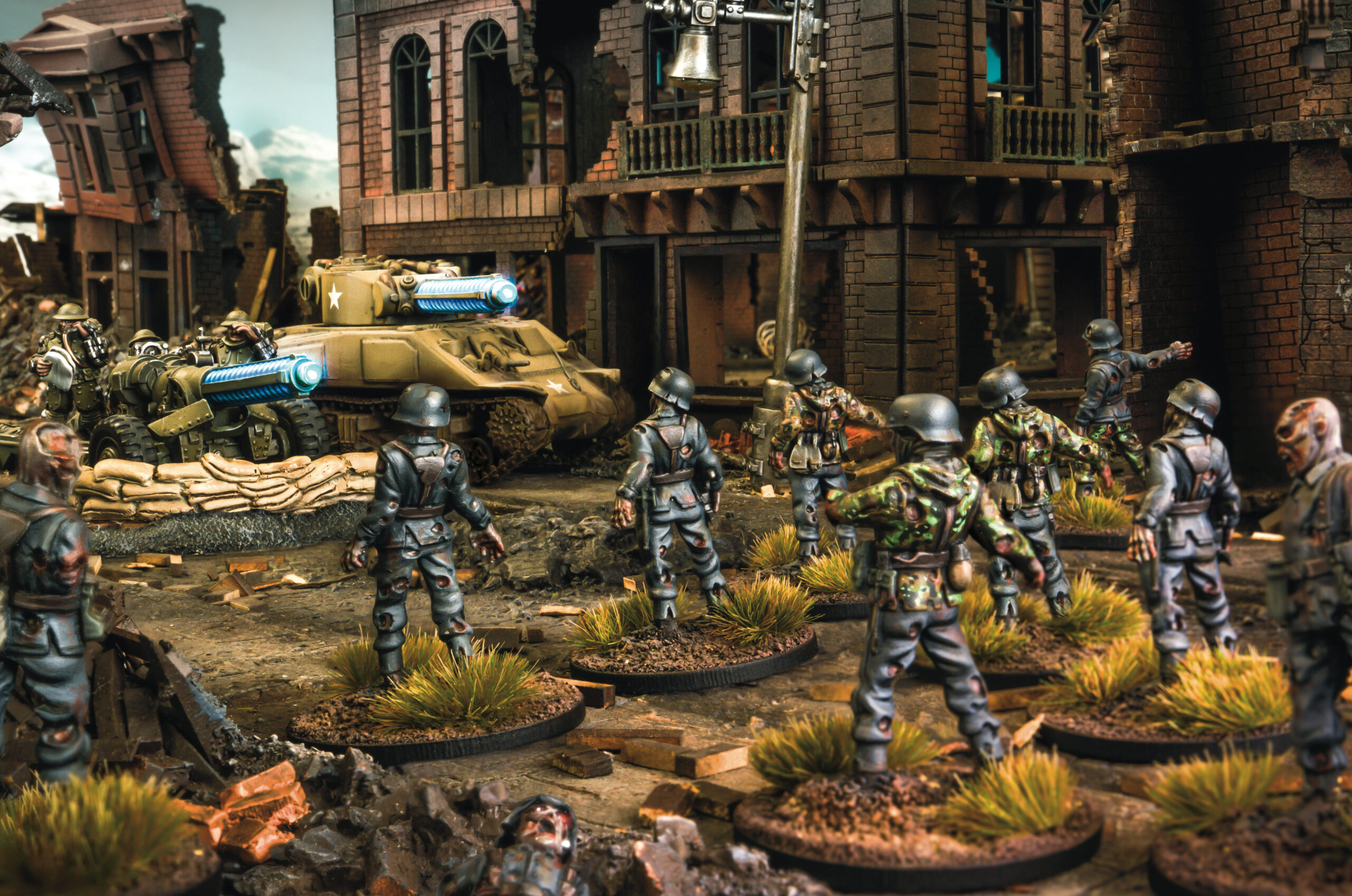
Of all the creations of the reclusive polymath Nikola Tesla, few are as iconic or as feared as the Tesla Cannon. These so-called ‘death rays’ are now a familiar sight in the hands of United States troops, their crackling discharge a potent symbol of American ingenuity and industrial might.
Hurling arcs of brilliant azure energy, these weapons unleash controlled devastation. They are capable of obliterating even the most entrenched positions and leaving the target with nowhere to hide. Yet, when pushed too far, the unwary operator may learn the cost of taming such volatile power…
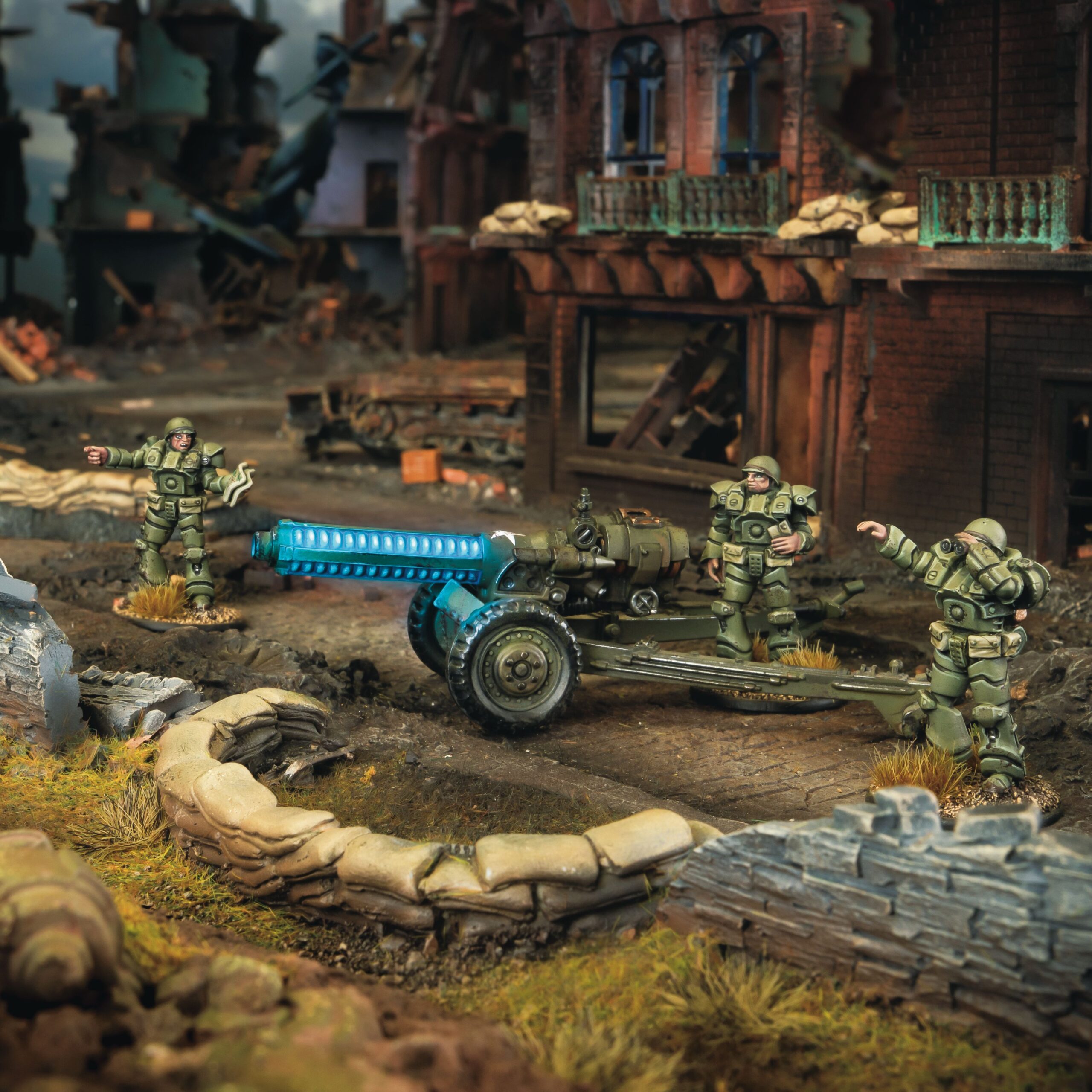
To master these weapons, we first need to understand them. We need to know how they function, how they strike, and how disciplined command turns raw lightning into victory. That’s the focus of today’s tactical primer — understanding how and when to unleash a lightning storm upon your opponents!
Understanding the Tesla Arc
Before we can apply Tesla technology effectively, we need to understand how it behaves on the battlefield. For this primer, we’ll focus on the two most common US vehicle-mounted Tesla weapon systems, the M21 Light Tesla Cannon and the M17 Tesla Cannon. Of course, much of what we discuss can also be applied to these weapons in the artillery role, and British Commonwealth players can also make use of the power of Tesla – and anyone planning to face an American force would be well served to take note of what they can do!
| Weapon | Range | Shots | Pen | Special Rules |
| M21 Light Tesla Cannon | 30″ | 1 | +1 | Team, Fixed, Rift Weapon; Tesla Arc (3) |
| M17 Tesla Cannon | 36″ | 1 | +2 | Team, Fixed, Rift Weapon; Tesla Arc (3) |
Both weapons share the Tesla Arc (3) special rule, the defining feature of Tesla design. When a unit equipped with a Tesla weapon fires, it can exhaust a Rift Die to activate the Arc. This produces a surge of chained electrical discharges, generating a number of extra shots equal to the Arc value.
In practical terms, the M17 Tesla Cannon using its ‘base’ profile fires a single shot. However, with Tesla Arc (3), it exhausts its Rift Die to produce four shots in total. It synchronises perfectly with the U.S. Army’s Arsenal of Democracy special rule, allowing multi-shot weapons to reroll a single roll to hit in each attack. This means Tesla Cannons strike with unerring accuracy, especially with their +1 to hit against Vehicles. When combined with Rift Weapons not suffering range modifiers to their Pen value, and Tesla ignoring Cover Saves, together, these rules form a lethal package.
Crews can deliberately Overload their Tesla weapons by exhausting a Surging Rift Die. This doubles the number of Tesla Arcs, creating an immense spike in firepower. This extra power is not without its dangers though, as after the attack is resolved, the firing unit suffers D6–2 Tesla Arc hits from its own weapon systems! With vehicles using their top armour to resist this feedback damage, and gun crews left hopeful that they remained correctly grounded, it’s a risk – but one that’s often worth taking!
Shock and Discipline – the M17 Tesla Cannon
The M17 Tesla Cannon sits at the heart of U.S. Rift-tech firepower. It occupies a space between the Light and Heavy Autocannons, trading a little range for reliability, flexibility, and sustained output. At 36″, it fires four shots per activation through Tesla Arc (3), keeping its full +2 Pen value at any distance and ignoring Cover Saves entirely. Where conventional gunners rely on field position and luck, Tesla crews rely on engineering.
When turned against infantry, the results are brutal and consistent. Against Veteran Infantry (DV 5), a Tesla burst averages around one and a half casualties—roughly matching a Heavy Machine Gun in the open, but staying just as effective when the target goes Down in Hard Cover. Even Power-Armoured or Rift-Enhanced troops (DV 6), who normally shrug off most small-arms fire, find that a single Tesla volley still inflicts more than a casualty on average.
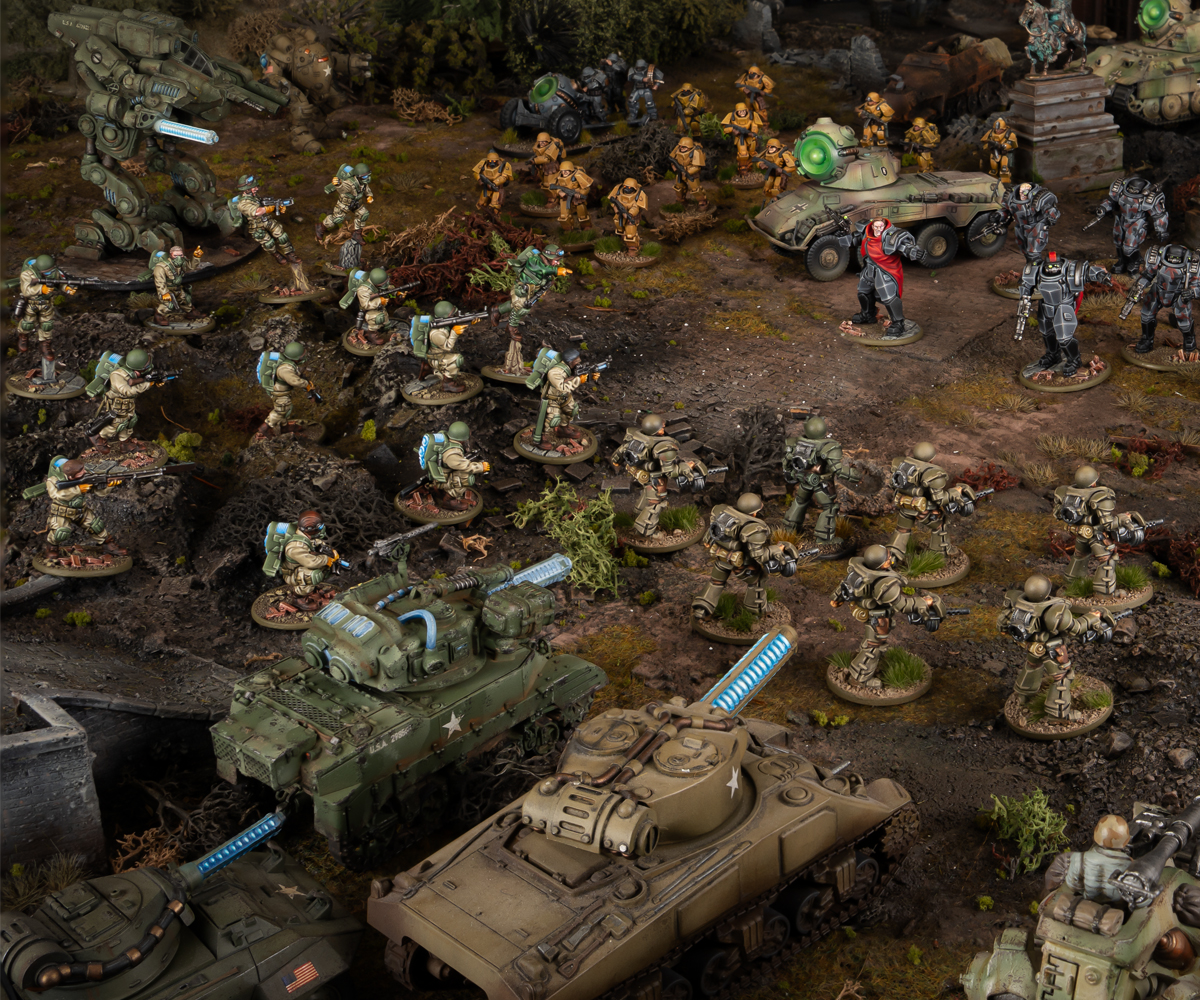
Against Advanced Power Armour or monstrous targets (DV 7), the weapon continues to perform, maintaining the same output that would see conventional guns halved or worse by dense terrain and defensive orders. The Heavy Machine Gun loses more than 80% of its stopping power once its target is dug in, while the M17 Tesla Cannon loses none. That reliability makes it the perfect tool for clearing fortified positions, neutralising infantry screens, and suppressing elite units before more vulnerable troops move in to secure the positions.
When its fire converges on a single target, the Tesla Cannon becomes something altogether different. Each arc compounds the next, delivering +2 Pen for every successful strike until the energy collapses into one catastrophic impact. In practice, most volleys strike with +6 to +8 Pen, putting the weapon on par with a Heavy Anti-Tank Gun for average performance, trading some longer range for slightly more stopping power. On a focused burst, the M17 lands 3+ arcs about 80% of the time—and you’re over twice as likely to spike to +8 Pen as you are to finish at +4 or less.
Against medium armour (DV 8–9), that translates to a roughly one-in-three chance to inflict serious damage, and even heavily armoured vehicles at DV 10 or higher remain vulnerable to a well-timed Tesla discharge.
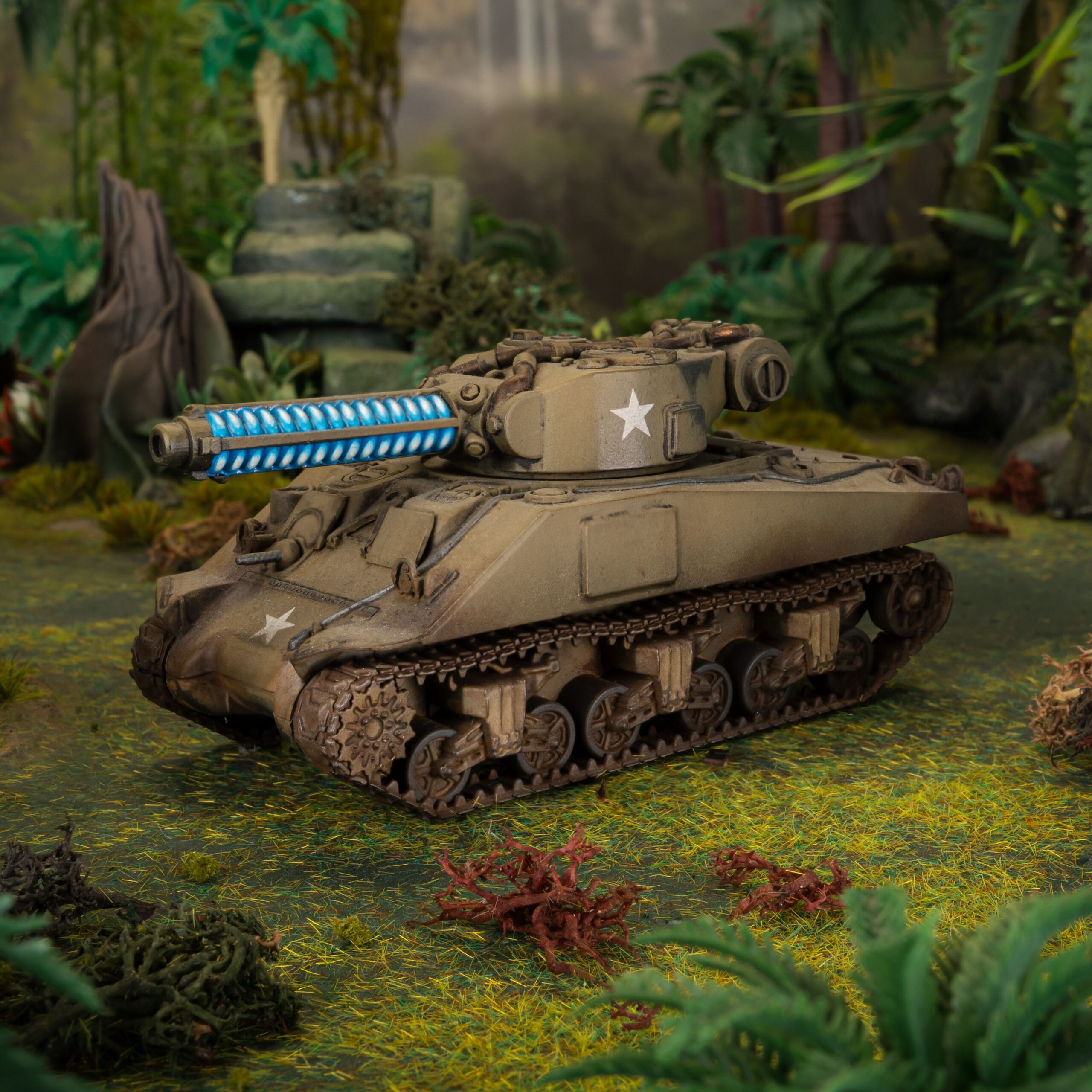
Mounting the M17 Tesla Cannon on a M4A9(T) Sherman really lets the weapon show what it can do. The Sherman’s mobility extends its practical range, and its Gyro-Stabilisers keep its fire accurate even on the move. The tank’s armour also gives a measure of safety when the crew chooses to Overload the weapon, unleashing a burst of Rift energy few targets can withstand. When overloaded, the M17 jumps from four to seven arcs, producing an average strike of +10 Pen against vehicles. More often than not this results in Massive Damage against even Super-Heavies. The Sherman’s DV 9+ hull soaks much of the feedback risk, with around a 60% chance of ignoring the Feedback entirely.
Against infantry, Overload typically adds one extra casualty against DV 6 or DV 7, but can really have shocking results against Basic Infantry you may otherwise struggle to dig out of cover. In the field, the M4A9(T) embodies the US Tesla doctrine: a steady platform for controlled power, able to keep pace with the advance and deliver precision Overloads that turn any engagement decisively in the crew’s favour.
The Science of Precision – the M21 Light Tesla Cannon
While the M17 Tesla Cannon unleashes devastation in its wake – annihilating whatever you point it at if you’re willing to unleash its full potential – the M21 Light Tesla Cannon is more of a surgeon’s scalpel. It’s a precise instrument that rewards timing and positioning. This is reflected in the platforms that mount it: fast, agile vehicles like the M8A3(T) Scout Car and M5A2(T) Stuart (both available with Recce) emphasise the shorter-ranged, more opportunistic playstyle of the Light Tesla.
It’s still a +1 Pen weapon, bringing a Rift Die, and its Tesla Arc (3) keeps the same rate of fire—just on a different profile. The M21 retains the M17’s anti-infantry capabilities as it still ignores cover. When targeting DV 5 troops in Heavy Cover, a Light Tesla burst typically removes one to two models, compared to just under one for an HMG firing 6 shots at the same target, making the M21 around 40% more effective in this situation.
It’s in the anti-armour role that the difference between the two Tesla Cannons is clearest. With shorter range and lower per-hit Pen, the M21 caps at +4 when all four arcs strike a single target. This is often good enough for light armour and vulnerable side or rear arcs, but Heavy and Super-Heavy fronts are off the menu… until you factor in the platforms that wield the M21 in battle.
Enter the M2A5 Linebacker.
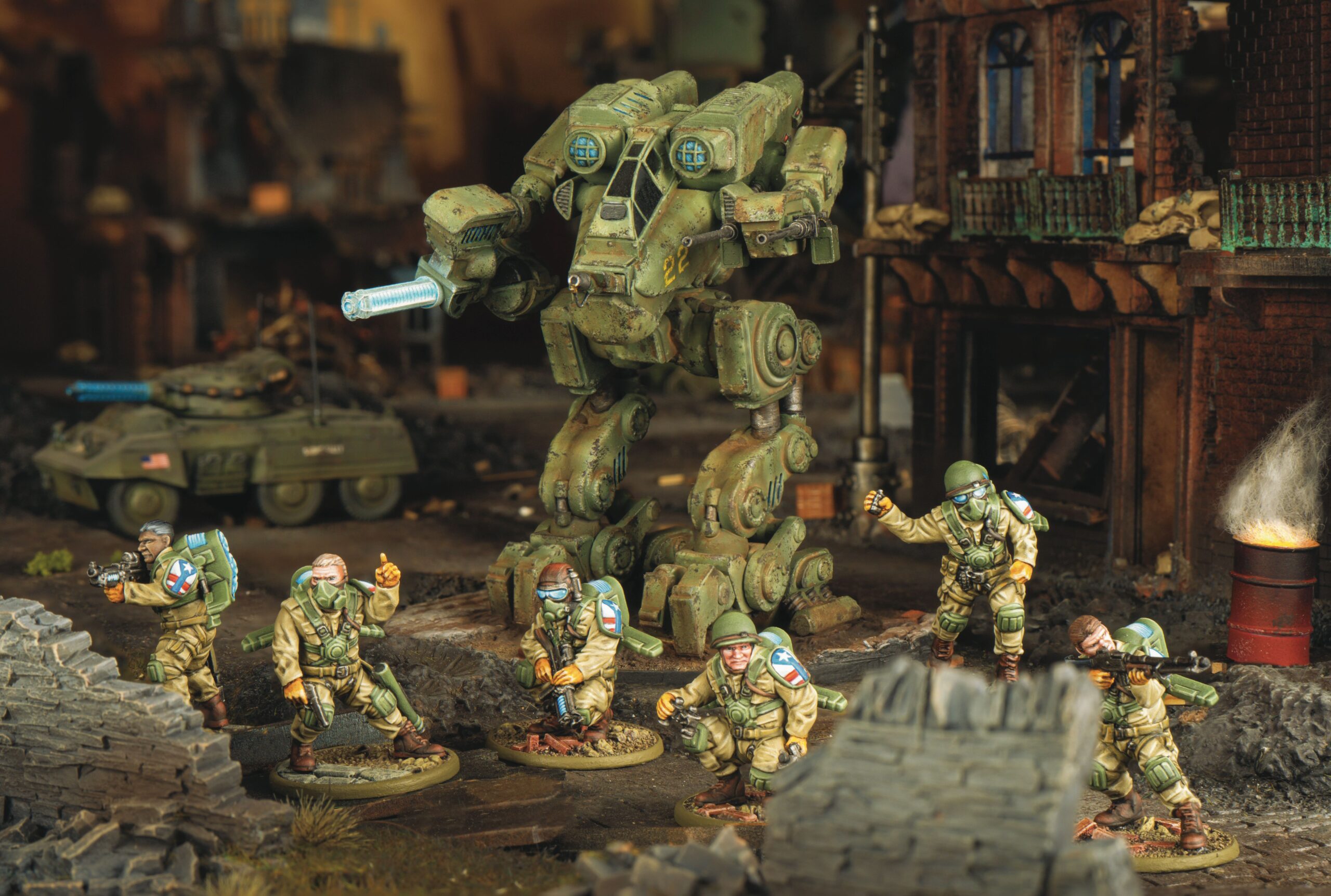
In practice, this mech’s mobility and firing arcs make point-blank shots easy to set up, allowing you to stack the +2 to hit from that with the +1 from Tesla Arc when targeting a vehicle.
This combination means you’re hitting on 2+, and Overloading the Light Tesla jumps you to seven shots, resulting in an average of 6.4 hits, i.e. a +6 Pen or +7 Pen, which is squarely in Heavy AT Gun territory.
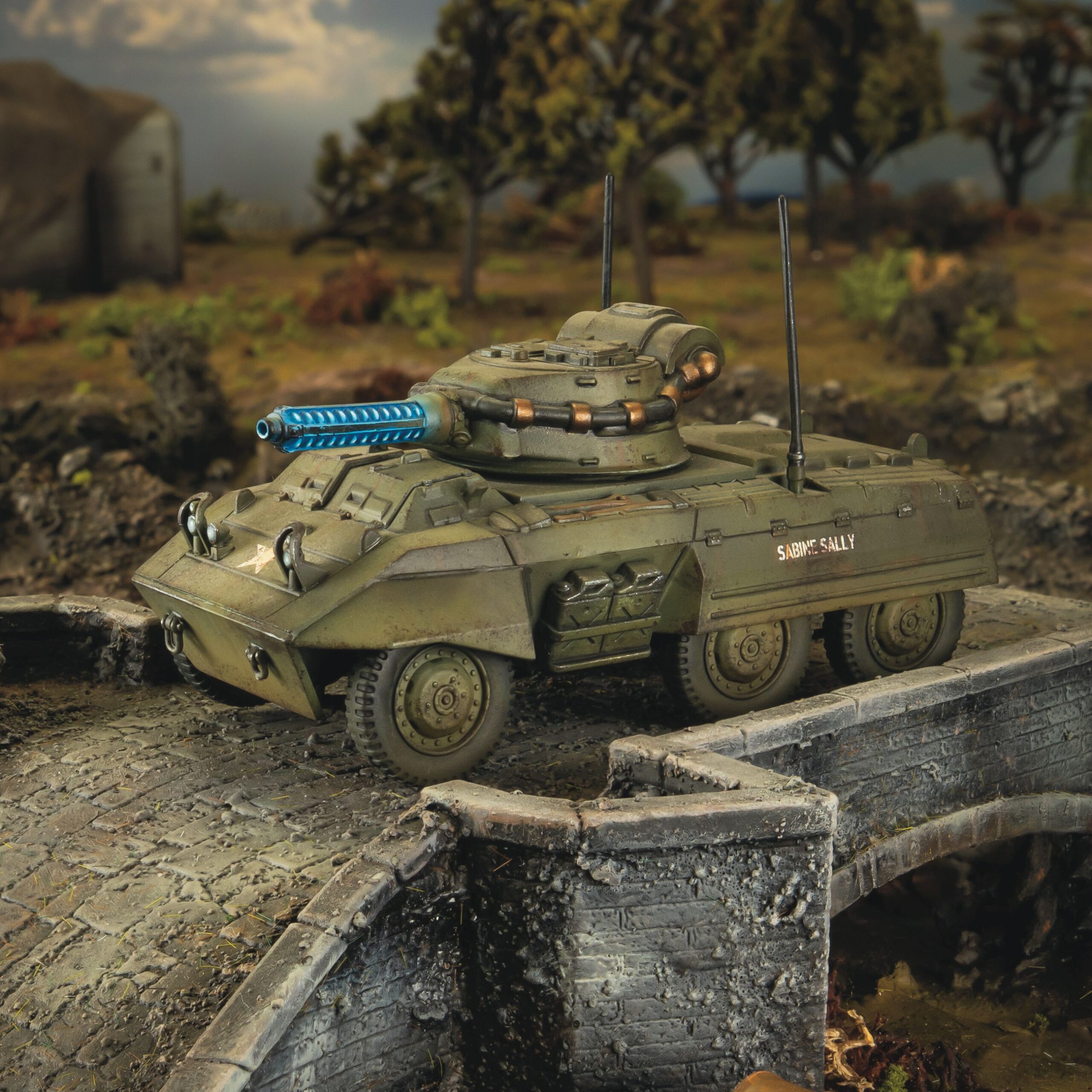
Real value can be found in the manoeuvrability and speed of the Linebacker and other platforms that commonly mount the M21. Side or even Rear shots are not uncommon, adding an extra +1 or +2 to your Pen Value, and even the M21 Light Tesla Cannon can threaten the enemy’s heaviest armour.
The risk of spending the Surging Rift Die to Overload the M21 is lower than it first appears. The weapon’s feedback effectively resolves as a single strike at Pen 0–5, weighted heavily toward the lower end—so most of the time there simply isn’t enough power reflected to punch through armour. In practice, the M8A3 Scout Car (DV 7+) resists its own discharge about 60% of the time. The M5A2 Stuart (DV 8+) ignores backlash in roughly 72% of cases, while the M2A5 Linebacker (DV 9+) does so in over 83%.
That reliability is the point. Overloading a Light Tesla isn’t a desperate gamble – it’s a calculated advantage.
The Mathematics of Control
Throughout this Primer, we’ve spoken about Tesla weaponry as if it’s always on – always firing at full power. In most cases, that assumption holds true, but it’s worth taking a moment to examine why. Tesla weapons draw their strength from the Rift Dice pool, and while the rules make it possible for a weapon to remain Exhausted, the odds of that happening are surprisingly small.
The single-die example:
Let’s start simple. Suppose your M17 is the only Tesla unit in your force, and it exhausts its Rift Die this turn. At the end of the turn, that die is rolled to determine its state for the next round. There’s a 50% chance it returns Active or Surging immediately. If it doesn’t, it gets added to the Dice Bag and you’ll assign it when drawn next turn. That die then has the same 50% chance to be usable, and if it comes up Exhausted again, Tesla’s Gift lets you re-roll it.
The odds of rolling Exhausted three times in a row – on the end-of-turn roll, the bag assignment, and the Tesla’s Gift re-roll – come out to just 12.5%. In other words, there’s an 87.5% chance your Tesla is fully powered again next turn! Better yet, about 29% of the time one of those rolls will come up Surging, meaning that even a lone Tesla Cannon is statistically more likely to surge than to stall.
Scaling up to a real Rift pool:
Now scale that logic up to a modest Rift pool and see how unlikely it is to not have an active Rift Dice – say, three exhausted dice at the end of the turn, perhaps two from Fireflies using Regroup in Hell and one from your M17.
All three Rift Dice would have to come up exhausted at the end of the turn, and then fail the assignment roll when drawn from the bag, and the Tesla’s Gift re-roll to remain exhausted. That combination only occurs around 3% of the time. Put differently, not only is there a 97% chance your M17 will have an active Rift Die next turn, you’re actually far more likely to see one of those dice come up Surging – around 42% of the time – than to lose them all to Exhaustion.
The United States’ Edge
Tesla’s true strength lies in its flexibility. Where most Rift-tech systems specialise — anti-tank monsters or dedicated infantry burners — Tesla can do both, often in the same turn. It trades range for versatility, raw power for consistency, and in doing so becomes the one weapon a US commander can rely on in any situation.
On the battlefield, that reliability scales with discipline. When paired with the United States’ Tough as Nails army rule, it’s not uncommon to see a Surging M17 backed by an Inexperienced Platoon Leader with Guts, ensuring the weapon fires twice in a single turn. It’s a perfect example of how US doctrine turns engineering precision into battlefield tempo.
Between Tesla’s Gift, the shared Rift Dice pool, and the Arsenal of Democracy, American forces deliver precise, repeatable firepower wherever it’s needed. In Konflikt ’47, the US doesn’t rely on the weather for its lightning storms – it builds them, controls them, and keeps them striking turn after turn. They might flicker, but they almost never fail.
Ready to get zapping? The awesome killing power of Tesla weaponry can be yours to control… simply click below!